
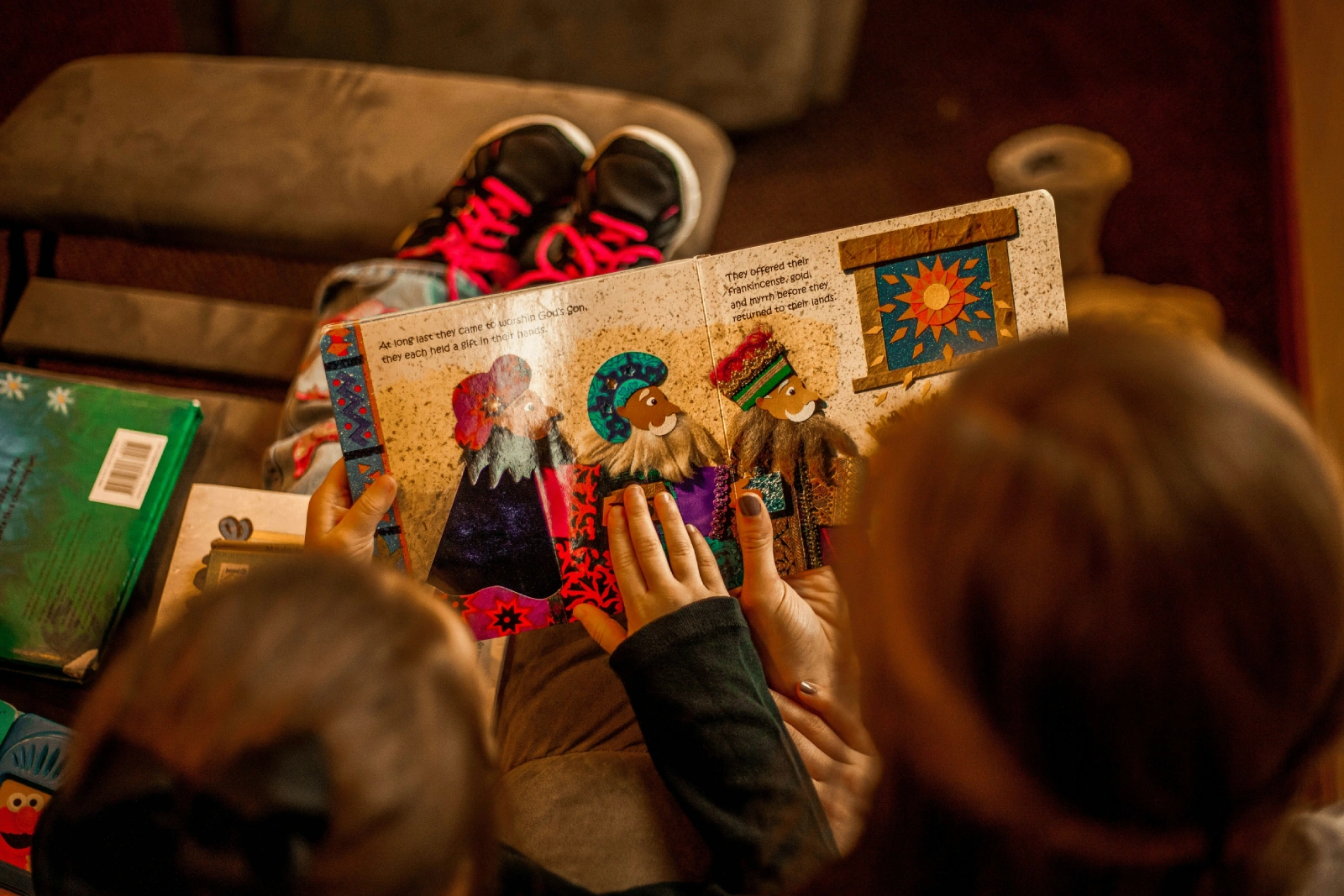
A picture book looks deceptively simple. A few dozen pages, large illustrations, minimal text. Yet in those few pages, something remarkable happens when a child and an adult share them together: a whole world of language opens up.
Picture books are among the most powerful language development tools available to parents and early childhood educators. They introduce vocabulary that rarely appears in everyday conversation. They model sentence structures that help children understand how language works. They carry emotional richness that teaches children to name and explore complex feelings. And they do all of this in the context of a warm, shared, pleasurable experience that makes the brain maximally receptive to learning.
Families researching the best montessori schools in bangalore for their young children will find that quality early childhood programmes place picture books at the very centre of their language curriculum — not as a supplement to language development, but as one of its primary engines.
In this blog, we explore exactly how picture books build language skills, what parents and educators should look for in a quality picture book, and how to read them in a way that maximises their developmental impact.
What Picture Books Do That Everyday Language Cannot
The vocabulary of everyday speech — even in educated, language-rich households — tends toward a relatively limited range of words. We ask children to ‘come here’, ‘eat your food’, ‘get your shoes’, and ‘be careful’. We use familiar words in familiar contexts, which means children hear the same words repeatedly.
Written language, particularly in quality picture books, is different. Authors choose words with precision and creativity. A child might encounter the word ‘shimmering’ in a book about stars, ‘ravenous’ in a story about a hungry creature, or ‘tranquil’ in a picture book about a quiet pond. These words would rarely appear in ordinary conversation — but heard in context, with the illustration reinforcing the meaning, they become accessible and memorable.
Research consistently shows that vocabulary is one of the strongest predictors of academic success across all subjects — and that the most reliable way to build a rich early vocabulary is through high-quality books read aloud, repeatedly, from an early age.
The Specific Language Skills Picture Books Develop
Vocabulary Acquisition in Context
Context is essential to word learning. When a child hears an unfamiliar word alongside an illustration that depicts its meaning, the brain makes an immediate, vivid connection that supports retention. A child who sees a sweeping landscape labelled ‘vast’ understands that word at a felt, visual level — not just as a definition to be memorised.
Quality picture books also tend to use new words multiple times within a single story, which reinforces learning through natural repetition. Hearing a word once is rarely enough; encountering it three or four times in meaningful context begins to make it the child’s own.
Understanding of Narrative Structure
Every story has a structure: a beginning that establishes characters and setting, a middle that introduces a problem or journey, and an end that resolves it. Children who are read to regularly absorb this narrative architecture naturally, long before they encounter formal story-writing instruction.
This understanding of how stories work underpins reading comprehension, creative writing, and even spoken communication — a child who understands narrative structure is better at telling their own stories, explaining sequences of events, and following complex information presented in narrative form.
Phonological Awareness Through Rhyme and Rhythm
Many of the best picture books for young children are built around rhyme, rhythm, and repetition. These features are not merely decorative — they serve a specific developmental function. Phonological awareness, the ability to hear and manipulate the sound units of language, is one of the strongest early predictors of reading success.
When a child finishes a rhyming line before the adult does, or notices that ‘cat’, ‘bat’, and ‘hat’ all end the same way, they are practising exactly the sound-level awareness that will support their decoding skills when formal reading instruction begins.
The best best pre school in bangalore programmes build picture book read-alouds into the daily schedule partly for this reason — the consistent exposure to rhyme and rhythm in high-quality picture books lays phonological foundations that letter-sound instruction alone cannot replicate.
Comprehension and Inferential Thinking
A picture book is not just a story — it is a puzzle. The illustrations often carry information that the text does not state explicitly. A character’s expression, the objects in a room, the colour palette of a scene — all of these communicate meaning that a perceptive child can learn to read and interpret.
When adults pause during a read-aloud to ask ‘Why do you think the character looks sad in this picture?’ or ‘What do you think is going to happen next?’, they are building inferential thinking — the ability to draw conclusions from incomplete information. This is one of the most sophisticated cognitive skills a child will need throughout their schooling.
Emotional Vocabulary and Social Understanding
Picture books are among the most effective tools available for helping young children understand and name their own emotions. A story in which a character feels jealous, frightened, embarrassed, or proud gives children language for experiences they have had but may not yet have words for.
This emotional vocabulary has practical, immediate benefits: children who can name their feelings are better able to communicate them and less likely to express them through behaviour. ‘I feel frustrated’ is a significantly more productive communication than a tantrum.
Parents looking at best preschools in bangalore for their children will find that the strongest early childhood programmes use picture books deliberately as vehicles for social-emotional learning — understanding that language development and emotional development are deeply intertwined.
What Makes a Picture Book High Quality?
Not all picture books are equally effective as language development tools. The strongest ones share several characteristics:
- Rich, precise vocabulary: Words that stretch a child’s existing language, used accurately and in meaningful context
- A satisfying narrative arc: A clear beginning, problem, and resolution that gives children a model for story structure
- Illustrations that extend the text: Images that add meaning not stated in the words, inviting interpretation and discussion
- Emotional authenticity: Characters who feel real and relatable, with inner lives that children can connect with
- Rhythm and language quality: Prose that sounds good read aloud, with attention to cadence and word choice
Books that meet these criteria will generate richer conversations, more opportunities for vocabulary exposure, and more sustained engagement than those that are merely entertaining in a surface way.
How to Read Picture Books for Maximum Language Development
Talk About the Pictures Before Reading
Before reading a word of text, take a moment to look at the cover and first few illustrations together. Ask ‘What do you think is happening here?’ or ‘What do you notice?’ This activates the child’s prior knowledge, builds anticipation, and begins to develop the habit of reading images as meaningful text.
Pause and Wonder Aloud
The most language-rich read-alouds are not simply a performance of the text — they are a conversation. Model your own thinking aloud: ‘I wonder why she decided to do that’ or ‘Oh, I didn’t expect that to happen.’ This demonstrates what active, engaged reading looks like from the inside.
Revisit Favourite Books Repeatedly
Repetition is not a limitation — it is a feature. Each re-reading of a familiar book allows a child to notice things they missed before, absorb vocabulary more deeply, and experience the pleasure of mastery and anticipation. Some books become richer the more they are revisited.
A top preschool in bangalore that genuinely understands early language development will have a collection of frequently revisited, well-loved books in its classrooms — books that children know intimately and return to with genuine delight — alongside a rotating selection of new titles that extend vocabulary and experience.
Conclusion: Small Books, Big Language
A picture book is a compact, efficient, and extraordinarily powerful language development tool. In the hands of an engaged adult reading aloud to an attentive child, it delivers vocabulary, narrative understanding, phonological awareness, inferential thinking, and emotional intelligence — all within the span of a pleasurable, shared experience.
The investment in a daily picture book read-aloud — consistent, unhurried, and genuinely enjoyed by both adult and child — is one of the highest-return language development activities available to any family. The books need not be expensive or numerous. What matters is the quality of the shared attention, the richness of the conversation, and the regularity of the habit.
Frequently Asked Questions
Q1. At what age should children start being read picture books?
From birth. Even very young infants respond to the sound of a parent’s voice, the rhythm of language, and the visual contrast of illustrations. Board books with simple, bold images are ideal from the first weeks of life. The language development benefits begin long before a child understands the plot — the habit of shared reading, and the positive emotional associations it builds, begin from the very first reading.
Q2. How many picture books should a child be read each day?
There is no fixed number — what matters more is regularity and quality of engagement than volume. Even one picture book read with genuine attention, conversation, and expression has more developmental impact than five books read through quickly with no discussion. Two to three books across the day, woven into natural transition moments, is a realistic and effective target for most families.
Q3. Are wordless picture books valuable for language development?
Highly. Wordless picture books require the adult and child to construct the story together from the illustrations alone, which generates rich, elaborate language from the child. The absence of text means the child must use their own vocabulary, sentence structures, and narrative understanding to tell the story — making it one of the most active language development formats available.
Q4. Should I correct my child's language when they respond to a picture book?
Generally, model the correct form rather than explicitly correcting. If a child says ‘the dog runned away’, respond naturally: ‘Yes, the dog ran away very fast, didn’t he?’ This implicit modelling is more effective and less discouraging than formal correction, and it keeps the conversation flowing rather than interrupting it.
Q5. Do digital picture books or e-books have the same language development benefits?
Physical books consistently show stronger language development outcomes in research, largely because digital formats introduce more distractions and reduce the quality of shared attention between adult and child. The interactive features of many e-books — animations, sound effects, games — tend to divert attention from the language itself. When screens are used, choose simple, text-focused digital books and maintain the same conversational approach as with physical books.