
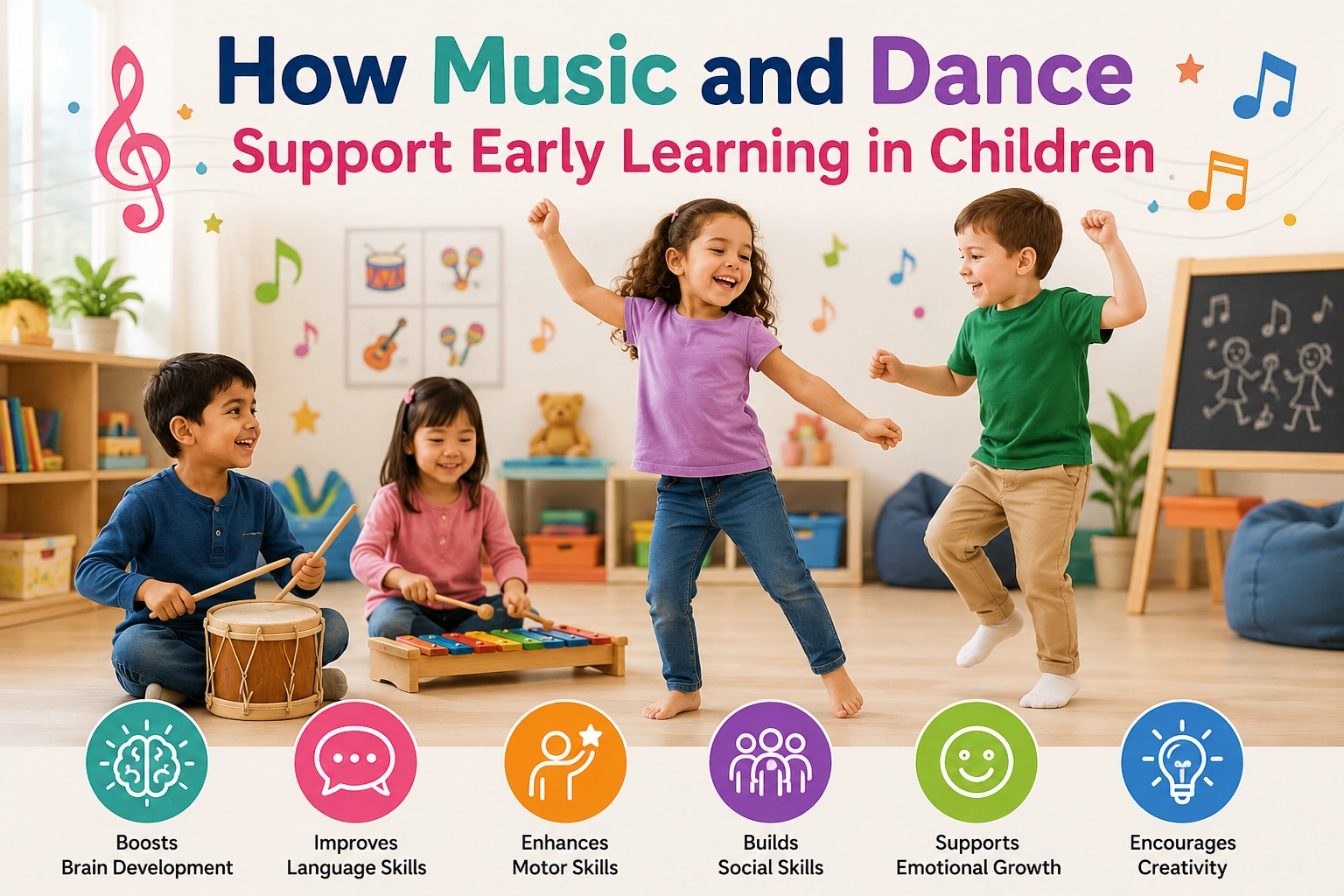
Watch a toddler hear a piece of music for the first time. Before they have any words for what they are experiencing, before anyone has taught them what to do, their body begins to respond — a gentle sway, a bounce, a grin that spreads from ear to ear. The human relationship with music and movement is not learned. It is wired in.
This instinctive responsiveness is not incidental. It is a window into one of the most important insights in early childhood neuroscience: music and dance are not enrichment activities layered on top of learning. They are fundamental modes of learning — ones that engage the developing brain more broadly, more deeply, and more joyfully than almost any other experience available to young children.
This article explores what music and dance actually do for the early learning brain, how they contribute to language, mathematics, social development, and physical growth, and what parents and early childhood educators can do to harness their extraordinary developmental potential.
The Neuroscience of Music and the Early Brain
Music activates more areas of the brain simultaneously than almost any other human experience. When a young child listens to or participates in music, the auditory cortex, motor cortex, prefrontal cortex, cerebellum, and limbic system all activate together — creating a uniquely rich pattern of neural engagement that strengthens connections across brain regions.
This broad activation has particular significance during the early childhood years, when the brain is at its most neuroplastic — most capable of forming new connections and establishing the neural architectures that will support learning across the lifespan. Music, during this critical window, is not just a pleasant experience. It is a form of brain exercise that builds the very infrastructure of cognitive development.
The same broad neural engagement occurs with rhythmic movement and dance. The integration of auditory processing (hearing the beat), motor planning (coordinating movement), sensory feedback (feeling the body in motion), and social attention (responding to others’ movements) makes dance one of the most neurologically comprehensive experiences available to a young child.
Music, Language, and Literacy
The relationship between music and language development is one of the most robustly established findings in early childhood research. Music and language share the same neural processing pathways — both involve the segmentation of sound into meaningful units, the detection of patterns and rhythms, the processing of pitch and timing, and the attachment of meaning to sequences of sound.
Phonological Awareness
Phonological awareness — the ability to hear and manipulate the sounds that make up words — is the single strongest predictor of early reading success identified in literacy research. Songs, rhymes, chants, and musical games are among the most effective ways to develop phonological awareness in young children.
When a child sings a rhyming song, they are practising hearing the sound patterns within words. When they clap syllables to a chant, they are developing the ability to segment words into their component parts. When they respond to the rhythm of a nursery rhyme, they are building the ear for language rhythm that later supports fluent reading. All of this happens naturally, joyfully, and without any sense of formal instruction.
Vocabulary and Narrative
Songs introduce vocabulary in the most memorable possible context — embedded in melody, rhythm, and often accompanied by actions that provide physical anchors for meaning. Children who regularly sing songs across a range of topics develop broader vocabulary than those who encounter language primarily through conversation, because songs consistently use richer and more varied language than everyday speech.
Songs with narrative structure — story songs, traditional ballads, and action songs with characters and sequences — also build the narrative comprehension skills that directly support reading and writing development. The child who knows what comes next in a familiar story song has already internalised the structure of narrative.
Listening Skills and Auditory Discrimination
Music trains the ear in ways that directly benefit language processing. Children who have rich musical experience develop finer auditory discrimination — the ability to hear subtle differences in pitch, timing, and sound — which translates into better discrimination between similar-sounding phonemes, more accurate word recognition, and stronger listening comprehension. This effect is particularly significant for children learning in a language that is not their first.
Families in Bengaluru researching early childhood settings and looking at best pre school in Bangalore options will find that early childhood environments with daily, structured music activities — singing circles, rhythm games, call-and-response chanting, and instrument exploration — consistently produce stronger early literacy outcomes than those where music is limited to occasional entertainment.
Music and Mathematical Thinking
The connection between music and mathematical development is deep and well-documented, though it surprises many parents who think of music as an arts activity entirely separate from numeracy.
Pattern Recognition
Mathematics is fundamentally the study of patterns — in numbers, in space, in relationships. Music is saturated with patterns: the regular pulse of a beat, the recurring structure of a verse-chorus form, the predictable sequence of a scale, the symmetrical phrasing of a melody. Children who are immersed in music from an early age develop highly sensitive pattern-recognition skills that transfer directly to mathematical thinking.
Research has consistently found that children with strong musical training demonstrate superior performance on spatial-reasoning tasks — the capacity to visualise and mentally manipulate shapes and structures — which is one of the most important foundations for mathematical thinking beyond basic arithmetic.
Counting, Sequencing, and Number Sense
Counting songs, rhythmic number chants, and musical games involving sequences all build the number sense and sequencing skills that formal mathematics instruction builds upon. The child who can accurately clap a rhythmic pattern of three beats, pause, then two beats has already demonstrated the kind of sequential numeric awareness that counting and simple arithmetic require. These connections are natural and automatic — which makes music one of the most painless and effective routes to early mathematical preparation.
Fractions and Division
Even basic musical concepts — a beat divided into two equal parts, a bar divided into four counts — introduce the fundamental mathematical ideas of division and fractions in a concrete, embodied form. Children who experience these concepts musically before encountering them symbolically in the classroom have an important conceptual foundation that makes abstract instruction more accessible.
How Dance Supports Physical and Cognitive Development
Dance integrates music with movement, and in doing so adds a range of developmental benefits that music alone does not fully provide.
Gross Motor Development and Coordination
The early childhood years are a critical period for gross motor development — the development of the large muscle systems that control posture, balance, locomotion, and coordination. Dance provides one of the richest possible environments for this development: it requires balance, coordination, spatial awareness, and the integration of sensory feedback from multiple body systems simultaneously.
Children who regularly engage in dance and rhythmic movement develop better physical coordination, stronger postural control, and more refined body awareness than those whose physical activity is primarily unstructured. These physical benefits are not merely physical — the coordination and body awareness developed through dance directly support the fine motor control that handwriting, drawing, and tool use require.
Spatial Awareness and Directionality
Dance teaches children to navigate space deliberately — to move forward, backward, and sideways; to be aware of their own body in relation to others; to follow directional cues and translate them into physical action. This spatial learning is foundational for mathematical reasoning, for reading (which requires understanding of left-to-right directionality), and for the geometric and spatial concepts that form a significant part of the primary school curriculum.
Crossing the Midline
Many dance movements require children to cross the body’s midline — to reach the right arm across to the left side of the body, or vice versa. This crossing of the midline is an important neurological milestone that supports the development of hemispheric integration — the coordinated working of the brain’s left and right hemispheres — which is associated with stronger reading, writing, and general academic performance.
Parents across Bengaluru who are evaluating early childhood options and specifically researching best preschools in Bangalore will find that settings with daily movement activities — not just free play, but structured music-and-movement sessions that combine rhythm, song, and deliberate physical activity — are providing experiences that make a measurable difference to children’s physical and cognitive readiness for school.
Music, Dance, and Social-Emotional Development
Beyond their cognitive and physical benefits, music and dance are profoundly social experiences — and their contribution to social-emotional development in early childhood is equally significant.
Emotional Expression and Regulation
Music gives children a non-verbal channel for emotional expression that is particularly valuable at an age when emotional experience is intense and verbal expression is still developing. A child who bangs a drum enthusiastically, sways to a slow melody, or stamps and jumps to an energetic rhythm is processing emotional experience through physical and sonic expression — which is both a healthy form of emotional release and a form of emotional intelligence development.
The regulation dimension is equally important. Music with a predictable, calming structure — a familiar lullaby, a slow and steady rhythm — has a physiologically measurable calming effect on young children. Many experienced early childhood educators use specific musical transitions (a particular song that signals tidying up, a gentle humming that precedes rest time) precisely because children’s bodies and nervous systems respond to musical cues in ways that facilitate the emotional regulation that transition times require.
Cooperation, Synchrony, and Belonging
Making music and dancing together are among the most naturally cooperative activities available to young children. Keeping a shared beat requires listening to others and adjusting one’s own behaviour in response — a foundational social skill. Singing in unison produces the physiological experience of synchrony — of moving with others in coordinated time — which research has linked to increased feelings of belonging, trust, and social bonding.
In culturally diverse early childhood settings, music from different traditions is one of the most effective tools for celebrating cultural variety in ways that are inclusive and emotionally accessible to all children. A song sung in a child’s home language, or music from a family’s cultural tradition, communicates a depth of respect and inclusion that no verbal declaration of values can quite match.
Among the best Montessori schools in South Bangalore, the Montessori approach’s emphasis on the whole child — physical, cognitive, social, and spiritual — makes music and movement natural and central parts of the daily environment, integrated not as timetabled subjects but as ongoing dimensions of a rich, responsive learning community that honours every aspect of the child’s developing self.
Practical Ways to Use Music and Dance at Home
Parents do not need musical training or professional expertise to provide their children with a rich music-and-movement experience at home. The most developmentally significant musical experiences are also the simplest.
- Sing together every day — morning routines, bath time, and car journeys are natural opportunities. The specific songs matter less than the regularity and shared enjoyment.
- Explore rhythm with household objects — wooden spoons, pots, containers filled with rice, and hand-clapping are all effective percussion instruments for toddlers.
- Move together to music — dancing with your child, bouncing a baby on your knee to a beat, and playing movement games to music all combine the benefits of music and physical activity.
- Listen widely — introduce children to a range of musical styles, including music from your family’s cultural tradition, classical music, world music, and children’s songs. Variety builds a richer musical ear.
- Attend live performances — even informal musical events (street performances, community concerts, school music presentations) expose children to the social and cultural dimensions of music in ways that recorded music cannot.
- Follow the child’s interests — if your child is drawn to a particular song, instrument, or style of movement, follow that interest with enthusiasm. Intrinsic motivation is the most powerful driver of sustained musical engagement.
Music and Dance in Quality Early Childhood Settings
The most effective early childhood settings treat music and dance not as Friday afternoon treats but as daily, integral components of the learning environment. In these settings, music accompanies transitions, structures group activities, supports language learning across subjects, and provides a consistent emotional thread through the day.
Educators in these environments have sufficient musical confidence to sing spontaneously, to lead rhythm activities without recorded music, and to use movement as a teaching tool across the curriculum — not just during dedicated movement sessions.
Parents researching options across the city and comparing the top preschool in Bangalore settings available to them should ask specifically about how music and movement are integrated into the daily programme — not just whether they are timetabled, but how frequently they occur, whether they are teacher-led or child-initiated, and whether they are used across the curriculum or treated as separate enrichment activities.
Conclusion
Music and dance support early learning in children not as pleasant extras to the serious business of education, but as two of the most neurologically rich, developmentally comprehensive, and intrinsically motivating learning experiences available to young children. They develop language, mathematical thinking, physical coordination, emotional regulation, and social connection simultaneously — and they do so in a mode that young children are naturally drawn to and deeply engaged by.
The child who grows up singing, moving, making music, and dancing is developing not just musical skill but a brain that is more connected, more expressive, more empathetic, and more prepared for the full range of learning that school and life will bring. In early childhood, music and movement are not the decoration on the cake of education. They are the flour and the eggs.